

Mohamed Thahir Sulaiman explores how the Global South has challenged mainstream notions of what it means for a state to be specially affected when it comes to customary international law formation. Sulaiman argues that the doctrine of specially affected states can be used to counteract hegemonic international law and amplify the voices of the Global South in shaping customary international law.
TWAILR: Reflections ~ 75/2025
Introduction
In its landmark decision in the North Sea Continental Shelf Case, the International Court of Justice (ICJ) established that the formation of customary international law (CIL) requires ‘state practice, including that of states whose interests are specially affected’. 1 This observation was made in the context of a dispute regarding the delimitation of the continental shelf, where Denmark and the Netherlands argued that Germany must accept delimitation based on the equidistance principle. The equidistance principle requires the boundary to be drawn at an equal distance from the nearest points of each country’s coast. Denmark and the Netherlands asserted that this principle had attained the status of CIL, first because it had been crystallised in Article 6 of the 1958 Geneva Convention that codified rules on international waters, and second due to its subsequent influence and acceptance through state practice. While the ICJ acknowledged that the principle had gained considerable acceptance, particularly among parties to the Convention, the ICJ held that the equidistance principle was not binding on all states because the principle lacked sufficient support from the practice of states ‘specifically affected’ by such delimitation, namely coastal states with adjacent coastlines. Consequently, the Specially Affected States Doctrine (SASD) introduced a qualitative dimension to the formation of CIL: the state practice and opinio juris of specially affected states are to be given greater weight in determining whether a norm has attained the status of CIL.
Despite the SASD becoming a cornerstone of CIL, it has been critiqued by scholars such as Chimni for serving as a tool of hegemonic international law. Chimni argues that ‘while in theory the state practices of all nations is of import in the formation of CIL’, the SASD enables the Global North to shape CIL by designating themselves to be ‘specially affected’.2 Such designation undermines the significance of the state practice of the Global South in custom formation, thereby excluding these states from meaningful participation in the identification of CIL and reinforcing the dominance of the Global North.
Recent developments in international law suggest a shifting interpretation of SASD. From international reports to the recently decided Advisory Opinion on Obligations of States in Respect of Climate Change, such developments demonstrate increasing challenges by the Global South of existing notions of what it means for a state to be specially affected. A possible result of this challenge could be the reimagination of SASD as a tool to counteract hegemonic international law and amplify the voices of the Global South in shaping CIL. Neither the ICJ articulation in the Continental Shelf Case nor Chimni’s critique fully conceptualize and appreciate this doctrine’s evolution and promise.
This reflection argues for a conceptualisation of SASD that empowers the Global South in custom formation and challenges hegemonic international law. This reflection first revisits the conceptual foundations of SASD, with a particular focus on redefining the notion of being ‘specially affected’. Second, this reflection examines recent developments that position the SASD as a site of contestation, highlighting its potential to amplify the concerns of the Global South. Finally, this reflection offers a methodological framework that integrates these developments into a broader strategy for challenging hegemonic international law and arguing for the historic and contextual interests of the Global South.
Reconceptualizing the SASD
The essence of SASD lies in the principle that the practice contributing to custom formation must also ‘include that of states whose interests are specially affected’.3 This principle has both positive and negative implications. Positively, it underscores the necessity of such states’ practice for the creation of custom. Negatively, it suggests that the absence of practice by specially affected states can prevent the formation of custom, even if non-specially affected states demonstrate consistent practice. These implications highlight the critical question: What does it mean for a state to be specially affected?
While no certain criteria are yet established, the notion of specially affected is frequently understood through the ‘most powerful states approach’ to SASD within the power structures of hegemonic international law. This approach, invoked by nations of the Global North such as the United States and the United Kingdom, particularly in the contexts of jus ad bellum and jus in bello, interprets ‘specially affected states’ as those states impacted by nearly all major political and legal developments in the global arena.4 Such interpretation confines the perception of being specially affected only to powerful nations, placing them in a dominant position over the formation of CIL.
For example, the United States responded to the International Committee of the Red Cross (ICRC) study on customary international humanitarian law by arguing that the ICRC failed to abide by the SASD. The US argued that the study falters in equating the ‘practice of States that have relatively little history of participation in armed conflicts’ with the ‘practice of States that have had a greater extent and depth of experience or that have otherwise had significant opportunities to develop a carefully considered military doctrine’.5 This interpretation is shared by scholars such as Meron who argued that formation of CIL must ‘recognize the greater involvement of some states in the development of the law of war’, with the ‘specially affected states’ being identified with nuclear powers and major military powers.6
Chimni critiques this conceptualization of SASD as one part of his broader critique of CIL and its formation, whereby CIL has historically and systematically reinforced hierarchies of power aligned with the interests of capitalism. Within his broader critique, Chimni identifies the SASD as a tool developed to reinforce hegemonic international law, likening it to other doctrines such as the persistent objector rule, which allows states to opt out of rules of CIL if they have consistently and clearly objected to the rule since their inception. He asserts that these tools serve primarily to advance the interests of the Global North, further marginalizing the Global South in the process of custom formation.
The conceptualization of SASD by Global North powers as well as by Chimni fall short of addressing the distinct and separate origins of tools of hegemonic international law, such as the persistent objector rule, when compared with the SASD. Unlike the persistent objector rule that was developed by the Global North, the SASD was not initially developed or argued by states of the Global North but rather has its origins in the ICJ’s brief mention in the Continental Shelf Case. This suggests that the SASD need not be understood solely through the lens of the ‘most powerful states approach’ but rather may be better interpreted as a context-dependent doctrine. The determination of whether a state is ‘specially affected’ could hinge on the specific circumstances surrounding the CIL in question, rather than on the relative power or influence of the state. This alternate conceptualisation is supported by the following three interpretations.
First, examining its origins in the Continental Shelf Case, SASD was not advanced by any of the parties to the dispute – Germany, Denmark, or the Netherlands – but by the ICJ. Denmark contended that even if Article 6 of the Geneva Convention had not been incorporated into CIL, the equidistance principle had nonetheless crystallized into customary law. In response, the ICJ held that the rapid emergence of a customary rule requires not only widespread state practice but also qualitative support from states that are ‘specially affected’ by the rule in question. The Court grounded its judgment not in hierarchical power dynamics among states, as the ‘most powerful states approach’ suggests, but in the specific relevance of continental shelf delimitation to certain coastal states.

Second, this interpretation of the ICJ’s invocation of the SASD is shared by the International Law Association (ILA). An ILA report argued that the ICJ’s observation introduced a qualitative element to identifying CIL and the Court’s intention was merely to ensure that CIL remains grounded in ‘political reality’ regarding whether the practice of delimitation by equidistance had constituted CIL, and not to suggest that ‘major powers have to participate in a practice in order for it to become a rule of general customary law’.7 Accordingly, the ILA noted that ‘who is “specially affected” will vary according to circumstances’ and the evolution of customary rules in specific domains are incumbent on practices of those states that are specially affected by those rules. Further, the ILA illustrates this interpretation of the SASD using the law of the sea as an area where coastal states, owing to their direct interests, are more likely to qualify as specially affected, particularly regarding CIL on offshore fisheries, compared to landlocked or less-involved states.
The designation of ‘specially affected state’ hinges not on the relative power of the state … but rather on the specific circumstances surrounding the customary norm in question.
Third, this interpretation is also supported by Justice Castro in his separate opinion in the Fisheries Case where he differentiated Iceland from other states, recognizing it to be specially affected by fishing customs owing to Iceland’s near-total reliance on fishing for its economy. A coastal state may be deemed to be specially affected with regard to fishing customs due to the significance the norms have on the state’s specific context irrespective of the relative power of the state itself.
These interpretations demonstrate alternative conceptualizations of the SASD to the ‘most powerful states approach’, where the designation of ‘specially affected state’ hinges not on the relative power of the state, as claimed by the Global North, but rather on the specific circumstances surrounding the CIL norm in question. Returning to Chimni, his argument accepts the Global North interpretation of the SASD as a tool of powerful states, yet he does not preclude the possibility of alternative interpretations. In advocating for the replacement of the structures of modern CIL, he emphasizes the role of discursive processes in the formation of CIL, an approach that would necessitate the category of ‘specially affected’ states to include ‘the interests of rule-takers’ as well as rule-makers.8 However, Chimni presents these discursive processes as a normative ideal to be achieved, rather than an existing interpretive possibility. Whereas a review of recent developments suggests that such a possibility can be reconceptualized in the present day to safeguard the interests of the Global South.
SASD as a Site of Contestation
By reframing the understanding of being ‘specially affected’ away from the ‘most powerful states approach’, recent developments reveal SASD to be not merely a tool of hegemonic international law but also a site of contestation where the Global South asserts its role in custom formation. Such a development is incomplete and has not yet led to definite outcomes but an effort at reconceptualization is discernible in two connected strands.
First, this change can be observed in reports from international bodies, namely the ICRC and ILC. As alluded to earlier, the ICRC in its 2005 report on Customary International Humanitarian Law identifies rules based on both physical acts of states such as battlefield behaviour, and verbal acts of states such as military manuals, official legal advisories and national legislation. In illustrating that the SASD is a context-dependent doctrine, the ICRC explains that who is specially affected ‘will vary according to circumstances’. For instance, states involved in developing laser weapons are specially affected in relation to the formation of custom in that area, but the same states may not be specially affected with respect to humanitarian law, where ‘specially affected states’ would include states that either provide or receive aid. This interpretation indicates that it is not only politically and militarily powerful states that can qualify as specially affected; states directly impacted by the consequences of certain practices may also qualify, thereby opening the possibility for the Global South to invoke the SASD more frequently. Similarly, the commentary to Draft Conclusion 8 in the Seventieth Report of the ILC also rejects the notion that the term specially affected states should be taken to refer to the relative power of states. The commentary emphasizes that such states are simply those that had the ‘possibility of applying the alleged rule’.
It is not only politically and militarily powerful states that can qualify as specially affected; states directly impacted by the consequences of certain practices may also qualify,
Unsurprisingly, such interpretations have faced opposition from the Global North. The US contended in its response to the ILC report that ‘custom must be only determined by practice of participating states’, advocating a narrower understanding of SASD.9 Moreover, in its response to the ICRC report, the US further contended that a distinction must be made between participating states and only some participating states should be regarded as specially affected. In contrast, China’s response to the ILC report presents a more inclusive view, arguing that any state with ‘concrete influence’ on the formation of a rule should be considered specially affected, regardless of its size or strength.10 This view is consistent with the interpretation in both reports as well as the interests of the Global South.
The second strand is evident in recent proceedings at the ICJ, as illustrated by two advisory opinions. The first is the Chagos Archipelago Advisory Opinion, where the African Union called for withdrawal of British forces from colonially-held Mauritian territory. In support of this position, the African Union argued that the ICJ’s earlier decision in Continental Shelf should be extended to CIL concerning postcolonial nations. Specifically, the African Union contended that such states are ‘specially affected’ due to their unique historical experiences as victims of colonialism, thereby employing SASD towards redressing historical injustices.

The significance of the invocation of SASD in such proceedings lies in the multitude of possibilities it unlocks for decolonized nations. For example, a potential challenge could be raised, as some have argued, regarding the return of cultural artifacts taken during colonial rule, with former colonies qualifying as ‘specially affected’ states due to their history of exploitation in such contexts. When considered together, the aforementioned two strands highlight that a broader application of the SASD does have the potential to amplify the voices of historically marginalized states and advance international law towards greater inclusivity and fairness, as advocated by Chimni. Evolving interpretations of SASD reveal a significant shift in the dynamics of international law towards effectively challenging power-centric frameworks to assert the interests of the Global South again and address systemic inequities to foster a more representative and just international legal system.
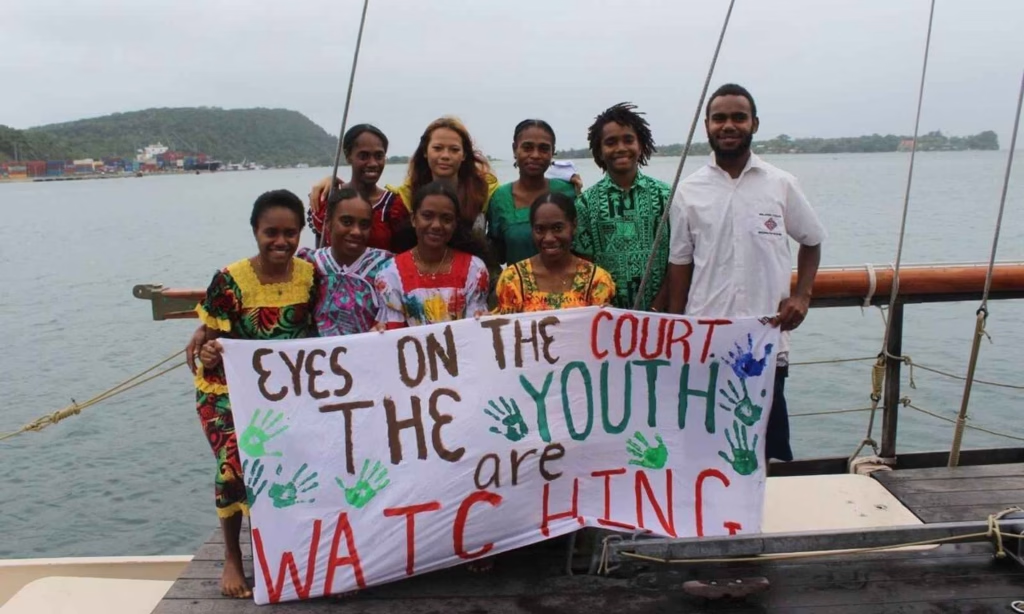
This expansive interpretation is also evident in the Advisory Opinion on the Obligations of States in Respect of Climate Change, where the question is raised as to the obligations of states in international law where harm has been caused with respect to small island developing states who are specifically affected by rising sea levels. Notably, Pakistan explicitly invokes the Continental Shelf Case to support its argument, asserting that the doctrine of ‘specially affected’ states does not refer exclusively to powerful states. Further, Pakistan draws upon the African Union’s submissions in the Chagos proceedings to advocate for an expansive view of the SASD that legitimizes its use by vulnerable and historically marginalised states. Although the ICJ in its advisory opinion did not directly refer to either the Continental Shelf Case or the Chagos opinion, it does recognize that there is a difference between the position of specially affected states and that of non-injured states ‘as concerns the availability of remedies’.
Some Concluding Thoughts on Methodology and Strategy
The SASD as a site of contestation for amplifying concerns of the Global South operates within entrenched hegemonic power structures that limit its transformative potential. Without a clear methodology, SASD may address short-term objectives in specific areas of law whilst undermining broader goals of challenging hegemonic structures, perpetuating selective inclusion, and leading to superficial reform. As is characteristic of critical approaches, interpretations of existing doctrines such as SASD may provide a basis for asserting the concerns of the Global South, but historical experience demonstrates that such efforts often fail to challenge the foundational power dynamics of hegemonic international law. While Global South interpretations are valuable in highlighting inequities, they risk being coopted into the very structures they seek to reform. Moreover, as Rajagopal underscores, the Global South is itself a contested and heterogeneous category, comprising both hegemonic and counter-hegemonic actors, rather than a monolithic victim of international law.
While Global South interpretations are valuable in highlighting inequities, they risk being coopted into the very structures they seek to reform.
Despite these risks, the reinterpretation of SASD creates some space to contest hegemonic structures if accompanied by a methodology and strategy aimed at combating hegemonic CIL. While no such methodology or strategy is currently practiced, recent events suggest certain emergent practices that hold promise. Building on these, this reflection proposes two practices for systemic and enduring reform.
First, as suggested by Chimni, the basis of CIL must shift from formal to material sources. Grounding CIL in sociohistorical contexts acknowledges the diverse power and development realities in the Global South.11 Such a shift is discerned for instance in the recognition of certain equitable principles within CIL, such as the principle of common but differentiated responsibilities and respective capabilities in the Rio Declaration, which acknowledges the varying stages of development among states. Such a shift entails rethinking development beyond the economic interests propagated by the Transnational Capitalist Class and reimagining trade and development through treaties and customs that reflect the material realities in the Global South.
Second, this shift toward material CIL would be strengthened through more collective concerted efforts by nations of the Global South. This involves the assertion of a unified Global South voice to articulate their interests and concerns. Given that these nations constitute the majority of global states, such efforts could significantly influence the determination of ‘widespread and representative participation’ in CIL formation.12 Mechanisms such as UN General Assembly resolutions and regional organizations can serve as effective platforms for asserting these concerns. Though often dismissed as rhetorical, such declarations do hold substantive value. For instance, returning to the Chagos case, the African Union’s declarations significantly influenced the ICJ’s decision. Similarly, coalitions like the G77 could also be strengthened to further this agenda. Further, as seen in South Africa’s approach to investment treaties, which subjects foreign investment disputes to domestic laws and courts, nations in the Global South could reject the interests of the Transnational Capitalist Class by prioritizing the protection of their constitutional goals and development tailored to the needs of their people.
An important element of this strategy is a proactive development of domestic legal frameworks and participation in norm formation. As Chimni notes, the Global South often misses out on CIL formation due to a lack of formal sources and participation. For instance, the report of the 73rd session of the UN attributes the absence of universal environmental conventions to the lack of comprehensive domestic legislation and standards, particularly in the Global South. Similarly, scholars increasingly argue today that legal frameworks on emerging technologies in developing countries must be specifically tailored to local contexts.
In fields such as artificial intelligence (AI), states in the Global South often merely replicate legal modelsdeveloped in the Global North without considering how such frameworks uniquely affect their own societal conditions. Rather, Global South states must develop new legal frameworks located within Global South discourse, interpretations of justice, and geopolitical representation. By strengthening domestic legal frameworks, the Global South can assert contextually relevant standards, countering norms crafted by nations of the Global North to suit their development priorities. Otherwise practices in the Global South in various fields from environment to regulation of emerging technologies will not be recognized as widespread, undermining their contribution to CIL.
Taken together, these two strands thus fulfil Chimni’s call for integrating historical and contextual interests into international law to promote equity and inclusivity. However, it is still necessary to acknowledge possible scepticism surrounding such efforts of reform. Much of this stems from a sense of déjà vu, recalling the failed reform efforts of the 1950s to 1970s. Notably, the push for a New International Economic Order (NIEO), the doctrine of Permanent Sovereignty over Natural Resources, and the Charter of Economic Rights and Duties of States did not achieve their transformative ambitions. This raises the inevitable question: why should similar efforts succeed now when they failed in the past?
In addressing this, it is crucial to recognize the significant differences between the postcolonial moment and the contemporary international order. While Global South countries often lacked effective state capacity and held negligible power within global structures during earlier reform initiatives, today many states in the Global South have become indispensable to the international economic system, with the West heavily dependent on their markets, resources, and labour. The Global South has greater leverage to influence commercial law and advocate for principles such as common but differentiated responsibilities beyond international environmental law. Moreover, legal frameworks in areas such as digital trade, AI governance, and financial technology, are currently in the process of emerging and are fast becoming defining elements of twenty-first century power relations. As noted earlier, Global South countries have distinct stakes in these areas.
Why should efforts succeed now when they failed in the past? … there are significant differences between the postcolonial moment and the contemporary international order.
The efforts of Global South collective action now should be understood as more than correcting existing inequalities but also as shaping emerging legal frameworks in ways that account for Global South concerns. Collective assertions at the international level, coupled with the development of robust domestic legal regimes, play a crucial role in shaping custom – a dynamic already evident in the Chagos decision. Past failures should therefore not be viewed as definitive limits but as lessons for adaptation. As Salomon observes, while the NIEO ultimately faltered, its core concerns continue to illuminate the enduring fault lines of international law today. A reimagined SASD, coupled with an appropriate methodology and strategy for reform, thus provides space to engage with these fault lines and reassert the concerns of the Global South in custom formation.
Mohamed Thahir Sulaiman is in the third year of his BA/LLB (Hons) at the National Law School of India University, Bengaluru, India.

- North Sea Continental Shelf Cases (Germany v. Denmark and Netherlands) [1969] ICJ Reports 227, at 43.
- BS Chimni, ‘Customary International Law: A Third World Perspective’ (2018) 112 AJIL, at 6.
- North Sea Continental Shelf Cases (Germany v. Denmark and Netherlands) [1969] ICJ Reports 227, at 43.
- Shelly Aviv Yeini, ‘The Specially-Affecting States Doctrine’ (2018) 112:2 AJIL 244; KJ Heller, ‘Specially-Affected States and the Formation of Custom’ (2018) 112:2 AJIL 192.
- John B Bellinger III and William J Haynes II, ‘A US Government Response to the International Committee of the Red Cross Study Customary International Humanitarian Law’ (2007) 89:866 International Review of the Red Cross, at 445.
- Theodor Meron, ‘The Continuing Role of Custom in the Formation of International Humanitarian Law’ (1996) 90:2 AJIL, at 249.
- Committee on Formation of Customary (General) International Law, ‘Statement of Principles Applicable to the Formation of General Customary International Law’, Final Report of the Committee, in International Law Association Report of Sixty-Ninth Conference (International Law Association, 2000) 1, at 26.
- Chimni (2018) 38.
- ILC, ‘Identification of customary international law Comments and observations received from Governments’ (30 April–1 June and 2 July–10 August 2018) UN Doc A/CN.4/716, at 34.
- ILC, ‘Identification of customary international law Comments and observations received from Governments’ (30 April–1 June and 2 July–10 August 2018) UN Doc A/CN.4/716, 31.
- Chimni (2018) 17.
- North Sea Continental Shelf Cases (Germany v. Denmark and Netherlands) [1969] ICJ Reports 227, at 43.